

The Importance of Following IFRA Usage Rates in Cosmetic Formulation

Updated: Aug 14
If there’s one area where formulators—especially beginners—tend to take risks, it’s fragrance
usage. Whether working with fragrance oils or essential oils, exceeding recommended limits can turn an otherwise beautiful formulation into a product that is unsafe, irritating, or even
non-compliant for sale.
This is where the International Fragrance Association (IFRA) comes in.
Understanding and following IFRA usage rates is not optional—it is a "critical part of safe,
professional cosmetic formulation".
What is IFRA?
The International Fragrance Association (IFRA) is the global authority that sets safety
standards for fragrance ingredients used in cosmetics and personal care products.
They work alongside scientific bodies like "Research Institute for Fragrance Materials (RIFM)"
to evaluate:
Skin irritation potential
Sensitization risks (allergic reactions)
Phototoxicity (sun-reactive ingredients)
Systemic toxicity
From this research, IFRA publishes maximum safe usage levels for fragrance materials in
different product types.
Why IFRA Usage Rates Matter?
1. Skin Safety & Irritation Prevention
Fragrance materials are made up of **complex chemical compounds**, many of which can
cause:
Skin irritation
Allergic contact dermatitis
Sensitization over time
Even natural essential oils are highly concentrated chemical mixtures, not inherently “safe” simply because they are natural.
➡️ IFRA limits are designed to prevent long-term skin damage, not just immediate irritation.
2. Product Type Changes Everything
One of the biggest mistakes formulators make is assuming:
“If 1% is safe, it’s safe in every product.”
This is "completely incorrect".
A fragrance that is safe at 1% in a candle or rinse-off product may only be safe at **0.2% in a leave-on product**.
Why?
Leave-on products stay on the skin longer
Lip products may be ingested
Eye-area products require extreme caution
Broken or shaved skin increases absorption
IFRA accounts for real-world exposure scenarios.

How to Read an IFRA Certificate
Every fragrance oil from a reputable supplier should come with an IFRA Certificate.
This document tells you:
The maximum usage % allowed
For each IFRA category
Based on the current IFRA amendment (e.g., 49th, 50th)
Example:
A fragrance may state:
Category 5 (Lotions): 0.8% max
Category 9 (Body Wash): 2.5% max
This means:
You must not exceed 0.8% in a lotion
But you *can* go higher in rinse-off products
The Hidden Risk: Overexposure & Sensitization
One of the most important reasons to follow IFRA guidelines is cumulative exposure.
Your customer is not using just your product.
They are using:
Body wash
Lotion
Perfume
Deodorant
All containing fragrance.
Even if each product is "within limits,” overuse can lead to:
Skin sensitization
Chronic irritation
Long-term intolerance to fragrance
IFRA limits are designed with aggregate exposure in mind.
Essential Oils vs Fragrance Oils: A Critical Note
A common misconception:
“Essential oils are safer than fragrance oils.”
This is not true.
Essential oils often contain:
High levels of allergens (like limonene, linalool)
Phototoxic compounds (like bergapten in citrus oils)
They are subject to **the same IFRA restrictions**.
Regulatory & Business Implications
If you are selling products, ignoring IFRA guidelines can lead to:
Product recalls
Customer injury claims
Insurance issues
Non-compliance with cosmetic regulations
Following IFRA is part of:
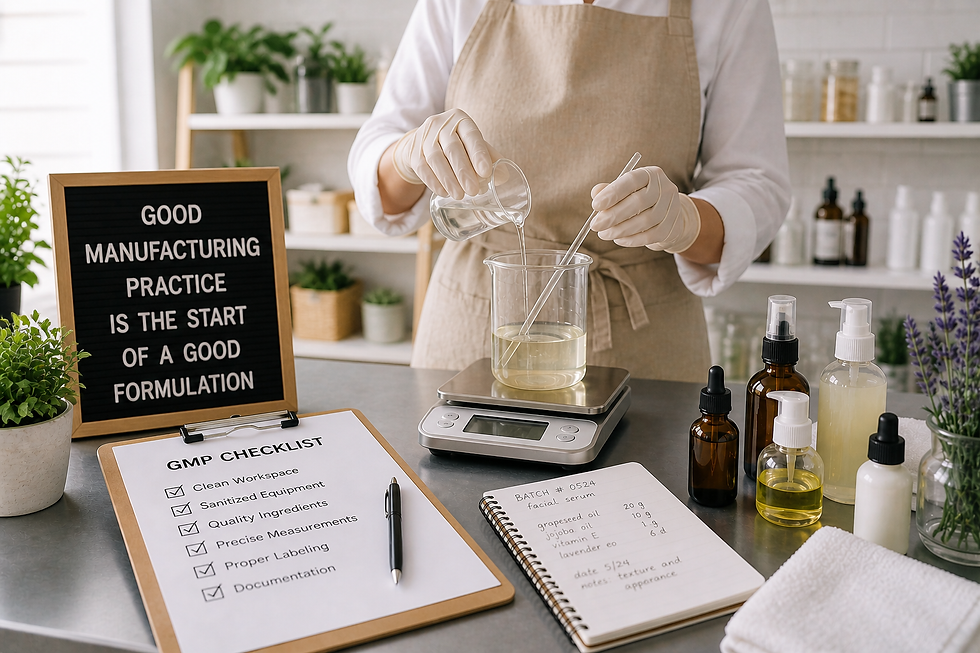
Good Manufacturing Practices (GMP)
Responsible formulation
Professional product development
Fragrance is one of the most enjoyable parts of formulation—but also one of the most chemically complex and potentially problematic.
Following IFRA usage rates ensures that your products are:
✔ Safe
✔ Professional
✔ Compliant
✔ Skin-friendly long term
As formulators, our responsibility goes beyond creating products that look and smell good—we must create products that are safe for repeated, long-term use.
Join our Patreon and Get Instant Access to Exclusive Formulations, Tutorials, and a Supportive Community!


Comments